
 Advertisement
Pedestrian Crosswalk & Driveway Safety Attendants for Urban Galas
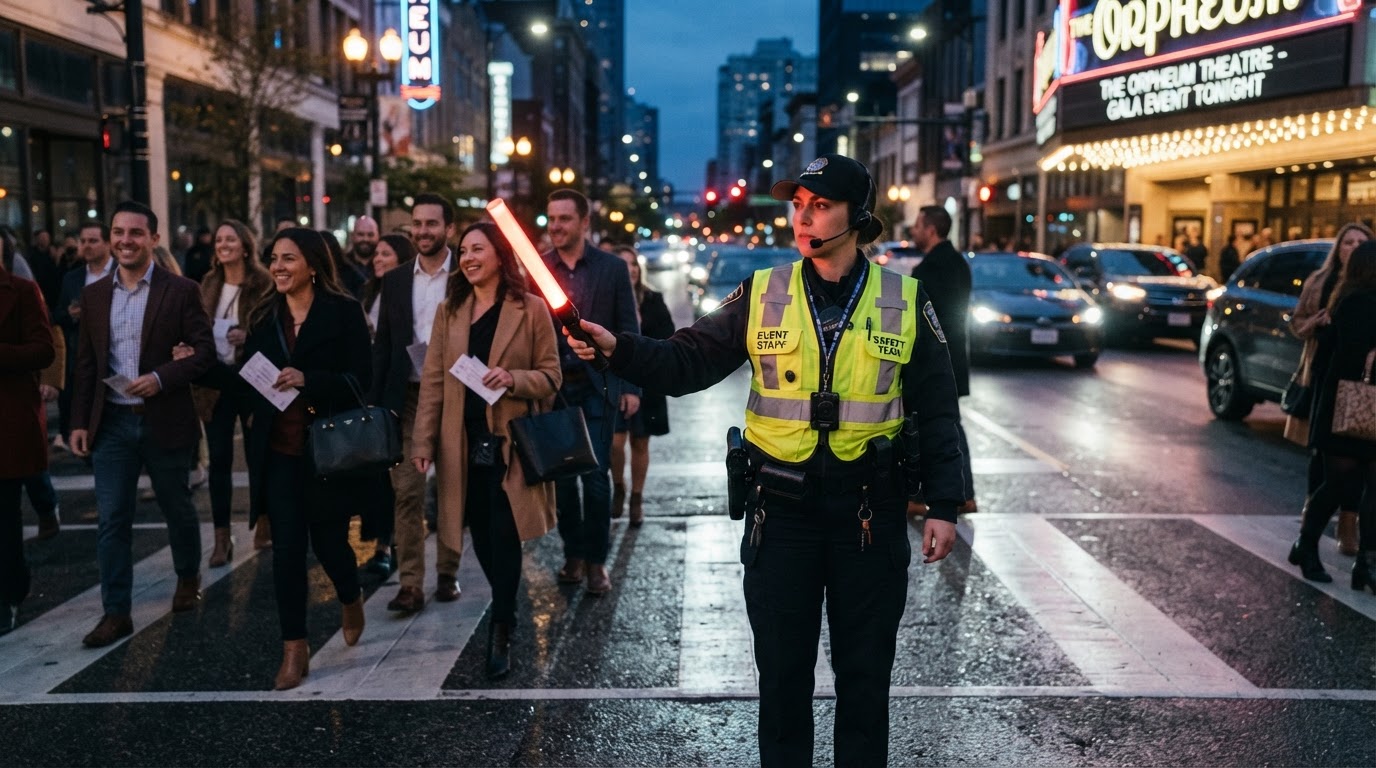
Protecting evening gala guests walking across busy street lanes between parking structures and venues.
High-visibility crosswalk captains equipped with LED batons and reflective uniforms guarantee safe pedestrian street crossing outside urban venues. In cities where the most desirable event spaces—historic theaters, rooftop ballrooms, downtown galleries—were built decades before modern parking requirements, guests routinely face a walk from a remote garage across active traffic. How that walk is managed determines whether it feels like a minor inconvenience or a genuine safety hazard, and the difference is entirely in the staffing and planning applied to the crossing.
When municipal city venues lack on-site surface lots, guests frequently park in parking garages located across multi-lane avenues. Expecting evening guests dressed in formal attire to navigate dark intersections alongside fast-moving traffic is dangerous. A guest in a floor-length gown and heels cannot move quickly, cannot see the pavement clearly in low light, and cannot hear approaching vehicles over the ambient noise of a downtown district. The risk is not theoretical: pedestrian-vehicle incidents at event crossings are a documented cause of injury, and the liability falls on the event organizer who failed to provide a safe route.
Certified crosswalk safety attendants actively monitor pedestrian signals, create safe crossing intervals with illuminated traffic batons, and escort guests safely across the boulevard. This visible commitment to guest safety is deeply appreciated by attendees. The attendant's role is not merely to wave a baton; it is to assess the traffic flow, identify a safe gap, halt oncoming vehicles with an authoritative hand signal, and escort the group across as a unit. A well-trained crossing captain commands respect from drivers and confidence from guests, turning a hazardous intersection into a managed, orderly crossing.
Staffing levels should match the expected pedestrian volume. A single crossing serving 200 guests over a 30-minute arrival window may need two attendants—one to hold traffic in each direction—plus a third to manage the queue on the far side and dispatch groups in controlled batches rather than a disorganized surge. For wider boulevards with a center median, station an attendant on the median to manage the second half of the crossing, ensuring guests are not stranded in the middle of the road when the light changes.
Lighting is a critical but often neglected element. The crosswalk should be illuminated with portable LED floodlights or reflective wands that make guests visible to drivers and make the crossing itself visible from a distance. A dark crosswalk is invisible to a driver approaching at speed, and reflective tape on an attendant's vest is insufficient if the driver cannot see the attendant until the last moment. Battery-powered, tripod-mounted floodlights are inexpensive, quick to deploy, and dramatically improve the safety of a nighttime crossing.
Coordination with local traffic authorities may be required for crossings that disrupt regular traffic flow. Many cities require a permit for a temporary crossing operation, and some will provide a police officer or municipal traffic controller for high-volume events. Engaging the local traffic department early—well before the event date—ensures compliance and may unlock resources that improve the crossing far beyond what a private attendant team can provide alone.
For guests with mobility limitations, the crossing requires additional attention. The route from the garage to the venue should be paved, level, and free of curbs that a wheelchair cannot navigate. If the only route includes a curb or steps, deploy a portable ramp and station an attendant to assist. An accessible route is not a courtesy; it is a legal requirement under the ADA, and an event that fails to provide one is both excluding guests and exposing itself to liability.
Finally, brief the guests. A simple sign at the garage exit—'Event crossing attended by safety staff, please wait for escort'—sets expectations and prevents guests from attempting the crossing on their own before an attendant arrives. The sign, combined with the visible presence of attendants in reflective gear, communicates that the organizer has anticipated the challenge and prepared for it, which reassures guests before they ever step off the curb.
Planning an event with more than 50 guest vehicles? Professional valet parking planning ensures safety, prevents traffic gridlock, and gives guests a memorable first impression. Browse verified valet parking companies in your area to discuss attendant ratios, staging logistics, and insurance coverage.
Need Event Valet Services?
Browse verified valet parking companies in your city.
Advertisement