
 Advertisement
ADA Compliant Event Parking & Shuttle Transport Guidelines
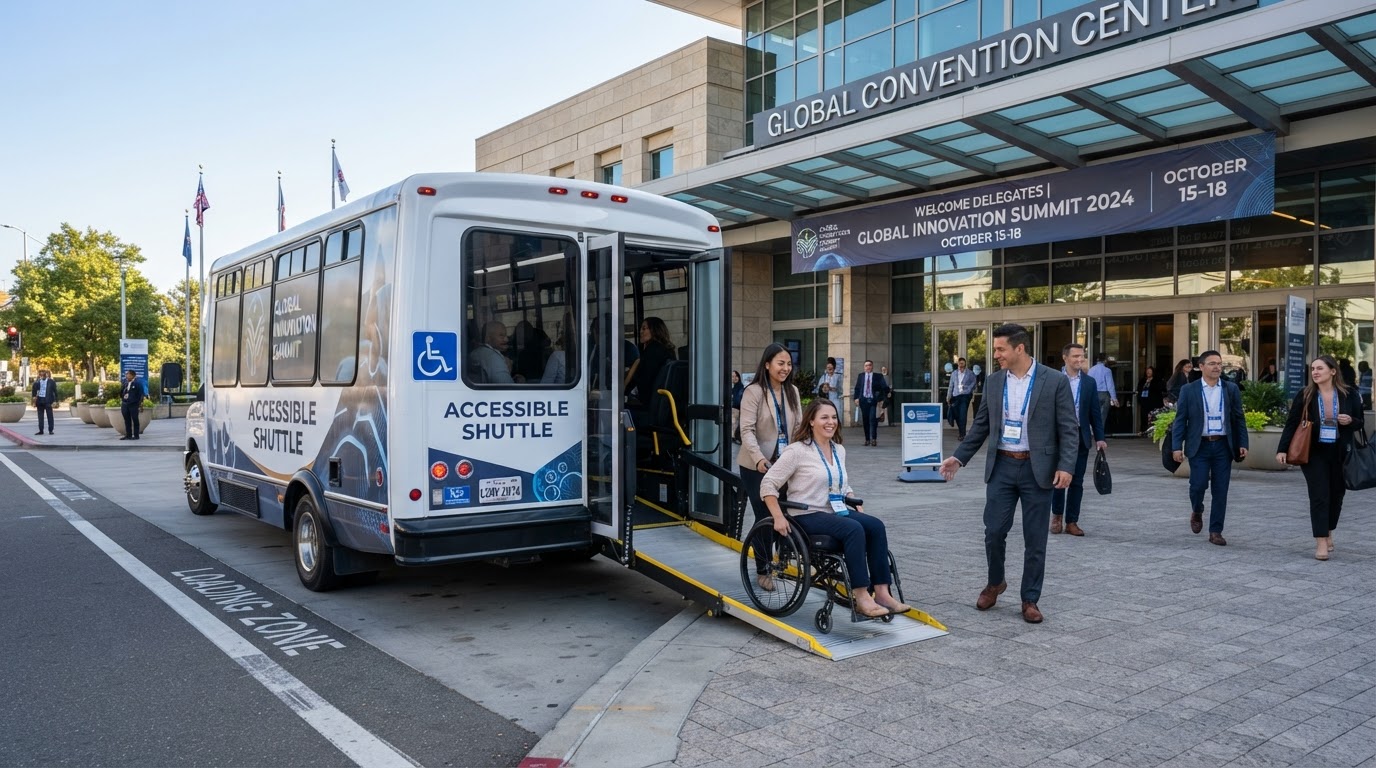
Meeting accessibility regulations for wheelchair-accessible vehicle staging and handicap ramp access.
Event organizers must ensure accessible parking spaces are positioned on flat, paved ground with proper van clearance and ramp access. Accessibility is not an optional courtesy extended to some guests; it is a legal obligation under the Americans with Disabilities Act and a moral obligation to ensure that every guest can participate fully in the event. Learn essential ADA valet compliance rules, and understand that an accessible parking operation is not a separate system bolted onto the main valet operation—it is an integrated component that must be designed in from the first planning conversation.
The Americans with Disabilities Act (ADA) establishes strict mandates regarding parking stall dimensions, access aisles, and maximum slope thresholds. When providing valet parking, event organizers must guarantee that accessible drop-off zones offer a continuous, obstruction-free accessible route to the building entrance. 'Continuous' is the operative word: a route that includes a curb, a flight of stairs, or a gap where the pavement gives way to gravel is not continuous, and it is not compliant. The route must be walkable by a person using a wheelchair or mobility scooter without encountering any barrier that requires assistance to overcome.
Accessible parking spaces must be located on the shortest accessible route to the entrance, not relegated to the far corner of the lot. The ADA specifies the number of accessible spaces required based on total lot capacity, and at least one of every six accessible spaces must be van-accessible, with a wider access aisle to accommodate a wheelchair lift. These dimensions are not suggestions; they are legal minimums, and a lot that fails to meet them exposes the event organizer to a complaint or lawsuit that is easily avoided by measuring the spaces before the first guest arrives.
If satellite parking lots and shuttles are deployed, at least one low-floor or lift-equipped wheelchair accessible transit van must be integrated into the shuttle rotation. Attendants must be trained in compassionate, respectful passenger boarding and tie-down securement. The training is not optional and not something a driver can improvise on the spot; improper securement of a wheelchair can cause serious injury during even a minor sudden stop, and an attendant who is unsure how to operate a lift can delay a guest and create an embarrassing, undignified experience.
The accessible shuttle should run on the same schedule as the standard shuttles, not on a separate, less frequent timetable that effectively makes accessible guests second-class attendees. If the accessible van is shared with another event or stored off-site, ensure it arrives before the first guest needs it. A guest who waits 30 minutes for an accessible shuttle while standard shuttles run every five minutes is a guest who has been told, through action rather than words, that their participation is less important.
Communication is essential. The event invitation and website should clearly describe the accessible parking and shuttle options, including the location of accessible spaces, the availability of accessible shuttles, and a contact number for guests who need additional assistance. Guests who use wheelchairs, have limited mobility, or are traveling with someone who does need to plan their arrival in advance; discovering at the curb that the accessible route is blocked or the accessible shuttle is unavailable is a failure that reflects on the entire event.
Train every valet attendant—not just a designated accessibility attendant—on the basics of accessible service. Every attendant should know the location of the accessible spaces, the route to the entrance, and how to assist a guest transferring from a vehicle to a wheelchair. An attendant who is unsure whether to offer assistance, or who offers it in a way that is patronizing rather than respectful, can undermine an otherwise accessible operation. The standard is simple: offer assistance, respect the guest's response, and treat every guest with the same warmth and professionalism regardless of how they arrive.
Finally, audit the accessible route on the day of the event, before the first guest arrives. Walk the route from the accessible spaces to the entrance, checking for curbs, slopes, obstacles, and surface conditions. A delivery truck parked across the accessible route, a curb ramp blocked by a planter, or a section of sidewalk closed for repair can render a compliant route non-compliant in an instant. A five-minute walk-through before the event opens catches these issues while there is still time to fix them, and it demonstrates the same attention to detail that distinguishes a well-run event from a merely adequate one.
Planning an event with more than 50 guest vehicles? Professional valet parking planning ensures safety, prevents traffic gridlock, and gives guests a memorable first impression. Browse verified valet parking companies in your area to discuss attendant ratios, staging logistics, and insurance coverage.
Related Guides
Need Event Valet Services?
Browse verified valet parking companies in your city.
Advertisement