
 Advertisement
Understanding Garage Keepers Legal Liability Insurance for Event Valet
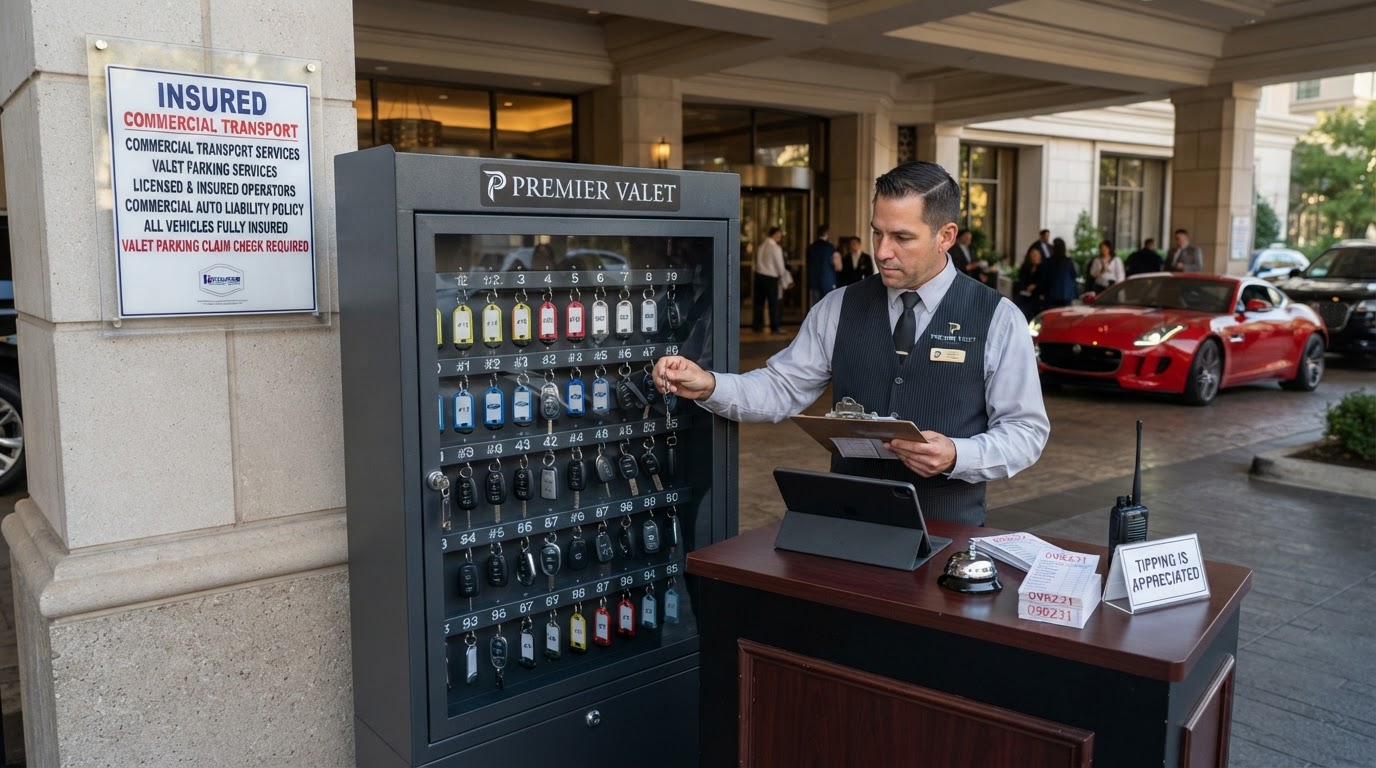
Key insurance coverage requirements every event planner must verify before hiring a valet company.
General liability insurance alone is not enough to cover customer vehicles under a valet provider's care. This is one of the most dangerous assumptions an event planner can make, and it surfaces only after something goes wrong—a scraped bumper, a stolen stereo, a tree limb that falls on a parked car—when the planner discovers that neither the venue's policy nor the valet's general liability covers the damage. At that point, the planner, the venue, and the valet company are left pointing fingers while the guest files a claim against their own insurance and vows never to attend another event at that venue. Learn why Garage Keepers Legal Liability and comprehensive non-owned auto insurance are mandatory before signing any valet contract.
A common misconception among event planners is assuming that a venue's standard commercial general liability policy protects guest automobiles. General liability covers bodily injury or property damage to third parties, but explicitly excludes vehicles held in the valet's care, custody, and control. The exclusion is standard across virtually all commercial general liability policies and is not a loophole a planner can negotiate away. The logic is that a vehicle in a valet's possession is a specialized risk that belongs on a garage policy, not a general liability policy.
Garage Keepers Legal Liability specifically insures against physical damage, collision, fire, and theft while the vehicle is being parked or staged. Planners should mandate minimum limits of $2,000,000 to $5,000,000 in direct primary coverage, accompanied by an additional insured certificate prior to event kickoff. 'Direct primary' is a critical distinction: it means the garage keepers policy pays first, before the vehicle owner's personal auto insurance, sparing the guest a deductible and a rate increase for damage they did not cause. A 'legal liability only' form, by contrast, pays only if the valet is proven legally liable, which can take months of dispute and leaves the guest fronting the cost in the meantime.
Non-owned automobile liability is a separate but equally essential coverage. It protects the valet company—and, by extension, the event organizer—if a valet attendant causes an accident while driving a guest's vehicle on a public road, such as when moving a car to an off-site lot. General liability excludes the operation of autos, so without non-owned auto coverage, a single accident involving a guest vehicle can expose the valet company to a judgment that exceeds its assets, leaving the event organizer as the next target in a lawsuit.
The certificate of insurance is the planner's proof that these coverages exist and that the venue and organizer are protected. Request it at least two weeks before the event, review it line by line, and verify that the policy expiration date extends beyond the event date. A common failure is accepting a certificate that expired months ago or that lists a different named insured. If the valet company cannot produce a current, accurate certificate, that is a red flag that extends beyond insurance to the company's overall operational discipline.
For events involving high-value or exotic vehicles, standard garage keepers limits may be insufficient. Discuss per-vehicle caps with the valet company and, if necessary, require a policy endorsement or a separate event-specific policy that raises the limit to match the value of the vehicles expected. The cost of additional coverage is modest compared to the potential exposure, and it demonstrates to high-net-worth guests that their property is being protected with appropriate seriousness.
Finally, document the insurance verification process. Keep the certificate on file, note who reviewed it and when, and confirm coverage verbally with the valet company's insurance broker if any term is unclear. In the unlikely event of a claim, this documentation is your evidence that you performed due diligence—a defense that can be the difference between a resolved incident and a protracted legal dispute that damages your reputation and your balance sheet.
Planning an event with more than 50 guest vehicles? Professional valet parking planning ensures safety, prevents traffic gridlock, and gives guests a memorable first impression. Browse verified valet parking companies in your area to discuss attendant ratios, staging logistics, and insurance coverage.
Related Guides
Need Event Valet Services?
Browse verified valet parking companies in your city.
Advertisement